PLA vs PETG Filament UK: Choosing Your 3D Printing Material
PLA vs. PETG Filament for Your UK 3D Printer Projects: The Ultimate Guide
Embarking on a 3D printing project in the UK, whether for a personal hobby or a business prototype, often starts with a crucial decision: choosing the right filament. With a plethora of options available, two materials consistently stand out as popular choices for FDM (Fused Deposition Modelling) 3D printers: PLA and PETG. Both have their unique strengths and ideal applications, and understanding these differences is key to achieving successful prints and bringing your ideas to life.
Here at PrintIn3D, your trusted 3d printer filament supplier uk, we’re passionate about helping you make informed decisions. We offer a hassle-free solution for custom 3d printing uk and a wide range of quality filaments, and we know that picking the perfect material is the first step towards printing your 3D dreams. Let's dive deep into the world of PLA and PETG to help you decide which one is the superior choice for your next endeavour.
For a more general overview of filament choices, you might find our guide on choosing the right plastic filament for your 3D printer in the UK helpful.
Quick Overview: PLA and PETG Filament
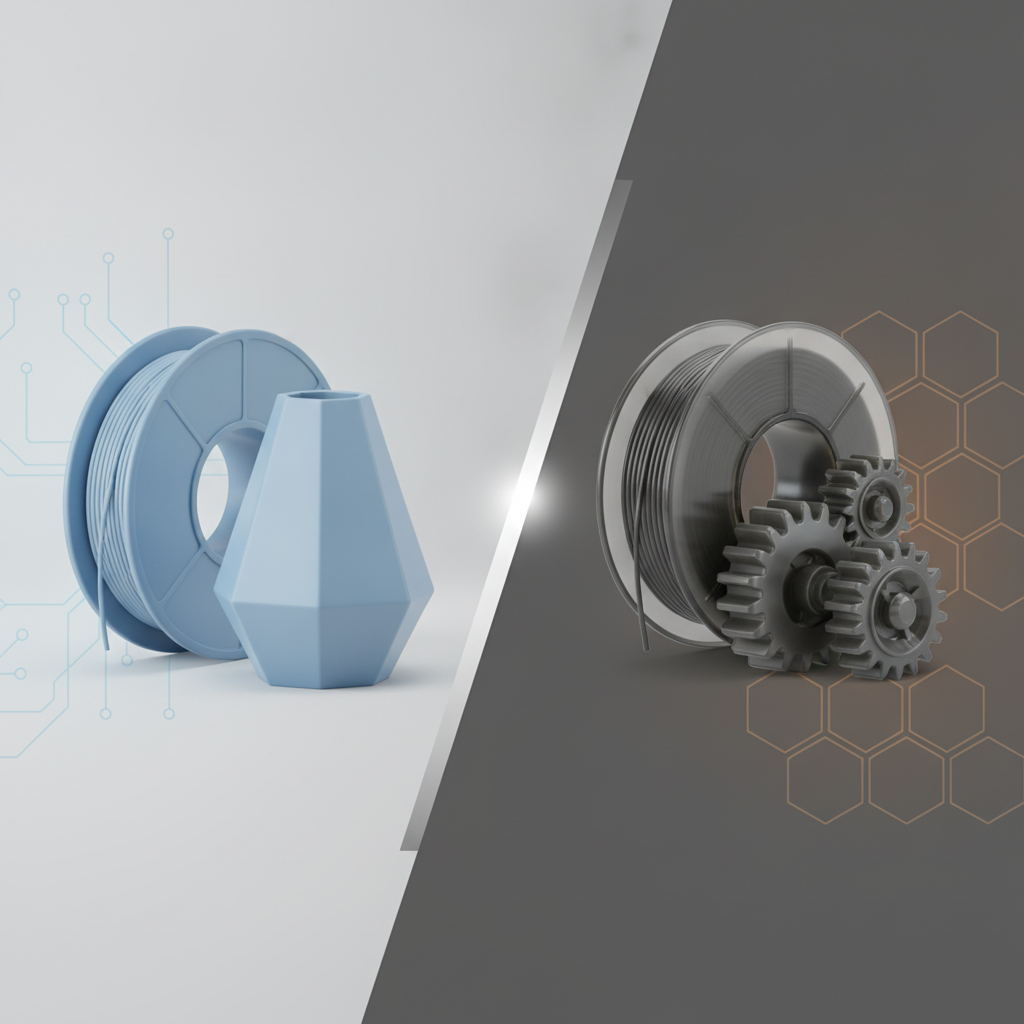
PLA (Polylactic Acid) is perhaps the most widely used 3D printing filament, especially favoured by beginners and those seeking an environmentally friendlier option. Derived from renewable resources like corn starch, it's known for its ease of printing, low warping, and excellent aesthetic qualities, making it ideal for decorative items and rapid prototyping where high strength isn't paramount.
PETG (Polyethylene Terephthalate Glycol), on the other hand, is a versatile thermoplastic that combines the best characteristics of both ABS and PLA. It offers greater strength, durability, and temperature resistance than PLA, making it a go-to choice for functional parts, mechanical components, and items that need to withstand more rigorous conditions. While slightly more challenging to print than PLA, its superior mechanical properties often justify the extra effort.
Feature-by-Feature Comparison: PLA vs. PETG
To help you visualise the differences, let's look at a detailed comparison across key criteria:
| Criterion | PLA (Polylactic Acid) | PETG (Polyethylene Terephthalate Glycol) |
|---|---|---|
| Ease of Printing | Generally considered the easiest filament to print with. It requires lower extruder and bed temperatures, experiences minimal warping, and adheres well to various surfaces. It's very forgiving for beginners and doesn't usually require an enclosure, making it a top choice for those just getting started with custom 3d printing uk. | More challenging than PLA but easier than ABS. Requires higher print temperatures (both extruder and bed) and can be prone to stringing if not properly dialled in. Good bed adhesion is crucial, and some users prefer an enclosure, especially for larger prints, to ensure consistent results. |
| Strength & Durability | Offers good tensile strength but is generally more brittle. Prints can snap under significant stress or impact, limiting its use for highly functional or load-bearing parts. It's fantastic for models where aesthetic appeal is more important than robustness. | Boasts excellent strength, toughness, and impact resistance. PETG prints are much less brittle than PLA, capable of flexing before breaking. This makes it an ideal material for functional prototypes, durable parts, and components that will experience wear and tear, truly excelling in 3d printing for product prototyping. |
| Temperature Resistance | Has a low glass transition temperature (around 60°C). This means PLA prints can soften, deform, or even melt when exposed to moderate heat, such as direct sunlight in a car or hot water. It is not suitable for applications that will encounter elevated temperatures. | Offers significantly higher temperature resistance than PLA, with a glass transition temperature around 80°C. This makes it a much better choice for parts that need to operate in warmer environments or for items that will be sterilised or used outdoors, providing more resilience for your custom 3d printing uk projects. |
| Flexibility | Known for its rigidity. While it holds its shape well, it has very little flex before breaking, which contributes to its brittleness. It's not the material for parts requiring give or elasticity. | Possesses a moderate level of flexibility, allowing it to absorb impacts without shattering. This characteristic is a major advantage for parts that might be bent, squeezed, or dropped, adding to its superior durability compared to PLA. |
| Applications | Ideal for decorative objects, figurines, educational models, conceptual prototypes, low-stress jigs, and aesthetic enclosures. If you need a quick, visually appealing print, PLA is your go-to. It's also excellent for early-stage development if you're exploring a 3d modelling service gb. | Perfect for mechanical parts, functional prototypes, protective components, outdoor applications, tool handles, phone cases, and food-safe containers (with appropriate precautions and specific filament types). Its robust nature makes it invaluable for industrial applications and detailed cad design service uk implementations. |
| Environmental Impact | Biodegradable and derived from renewable resources like corn starch, cassava, or sugarcane. It breaks down faster than most plastics in industrial composting facilities, making it a more environmentally conscious choice. | While not biodegradable, PETG is highly recyclable (often found in water bottles). However, curbside recycling facilities may not accept 3D printed PETG due to additives or unique processing. It is still a petroleum-based plastic. |
| Post-Processing | Relatively easy to sand, paint, and glue, although its brittleness can sometimes make fine sanding challenging without breaking thin features. It responds well to various finishing techniques to achieve a smooth surface. | Can be more challenging to sand due to its toughness and tendency to soften slightly with friction. It can be bonded with certain adhesives but may require more specific techniques. Some solvents can be used for smoothing, but caution is advised. |
| Cost | Generally the most affordable 3D printing filament on the market, making it an excellent choice if you're looking for cheap 3d printer filament uk for large volumes, prototypes, or hobby projects where budget is a primary concern. | Typically slightly more expensive than PLA, reflecting its superior mechanical properties. However, its cost-effectiveness becomes apparent when considering the durability and functionality it offers for more demanding applications. |
Pros & Cons of PLA
Pros of PLA Filament:
- User-Friendly: Incredibly easy to print, with minimal warping and no heated bed often required. Perfect for beginners or anyone seeking a hassle-free printing experience.
- Excellent Aesthetics: Produces prints with a smooth finish and often vivid colours, making it ideal for visual models and decorative items.
- Low Odour: Prints with a barely noticeable, sometimes sweet, smell, unlike some other filaments that produce strong fumes.
- Biodegradable: Made from renewable plant-based resources, offering a more environmentally friendly option for your 3D printing endeavours.
- Affordable: Often the most cost-effective filament, great for large batches or when budget is a key consideration.
Cons of PLA Filament:
- Low Heat Resistance: Not suitable for parts exposed to high temperatures, as it can deform or melt.
- Brittle: Can be prone to snapping or breaking under stress or impact, making it less ideal for functional, load-bearing parts.
- Poor UV Resistance: Degrades over time when exposed to direct sunlight, limiting its use for outdoor applications.
- Limited Durability: Less robust than other plastics, meaning prints might not last as long in demanding environments.
Pros & Cons of PETG
Pros of PETG Filament:
- High Strength & Durability: Offers impressive impact resistance and flexibility, making it excellent for functional and long-lasting parts.
- Good Temperature Resistance: Can withstand higher temperatures than PLA, expanding its range of applications to warmer environments.
- Food-Safe Options: Many PETG filaments are FDA approved for food contact, making them suitable for containers or kitchenware (always check specific manufacturer details).
- Chemical Resistance: Generally resistant to water, weak acids, and some solvents, adding to its versatility.
- Recyclable: While not biodegradable, PETG is a widely recycled plastic, contributing to a more circular economy.
Cons of PETG Filament:
- More Challenging to Print: Requires higher temperatures and can be prone to stringing or oozing if print settings aren't optimised.
- Hydroscopic: Tends to absorb moisture from the air, which can lead to print quality issues like bubbling or weak layers. Proper storage is essential.
- Adhesion Issues: Can sometimes adhere too strongly to print beds, potentially damaging the surface if not managed properly (e.g., using a release agent).
- Slightly Higher Cost: Generally more expensive than PLA, which might be a factor for very large or numerous prints.
Who Should Choose Each Filament?
Choose PLA if you are:
- A Beginner: Its ease of use makes it the perfect starting point for anyone new to 3D printing.
- Making Decorative Items: Ideal for figurines, artistic models, cosplay props, and gifts where visual appeal is paramount.
- Creating Conceptual Prototypes: Perfect for early-stage iterations and visual mock-ups, especially if you're using a 3d print files design service to rapidly visualise your concepts.
- Printing Indoors: Best for items that won't be exposed to high heat or direct sunlight.
- Budget-Conscious: For those looking for cheap 3d printer filament uk for high-volume or non-critical prints.
Choose PETG if you are:
- An Experienced Maker: Ready to fine-tune your printer settings for superior material properties.
- Creating Functional Parts: Essential for mechanical components, jigs, fixtures, and replacement parts that require durability and strength.
- Producing Prototypes for Testing: Ideal for 3d printing for product prototyping where the part needs to be robust enough for real-world testing.
- Printing Outdoor Items: Its higher temperature and UV resistance make it suitable for garden accessories, drone parts, or other outdoor enclosures.
- Working with Food-Contact Items: If you need to print containers or utensils (always verify the filament's specific food-safe rating).
- Considering a 3d scan to cad service: Often, the goal of reverse engineering a part is to reproduce it with functional properties, which PETG can provide.
Verdict: Your 3D Printing Partner in the UK
There's no single "best" filament between PLA and PETG; the ideal choice always depends on your specific project requirements. PLA shines for its user-friendliness, aesthetic qualities, and affordability, making it a staple for hobbyists and early-stage prototyping. PETG, while slightly more challenging to print, offers superior strength, durability, and temperature resistance, making it invaluable for functional parts and demanding applications.
At PrintIn3D, we understand that sometimes you need the fastest turnaround for your projects, which is why we offer services like 3d printing express uk. Whether you're a seasoned professional looking for robust materials or a complete beginner exploring the potential of custom 3d printing uk, we are your reliable partner. We supply high-quality PLA and PETG filaments from trusted brands like Bambu Lab and SUNLU, and our expert team is always on hand to help you navigate your material choices, offering friendly WhatsApp support every step of the way.
If you're unsure which filament is right for your design, or if you're exploring options like a 3d scan to 3d model service uk to get your idea print-ready, don't hesitate to reach out. We're here to help you turn your concepts into tangible realities with ease and expertise.
Ready to Print Your Ideas?
Explore our range of high-quality PLA and PETG filaments and custom 3D printing services today on our 3D Printer Filament page and bring your next project to life!